
'Amrishji had a fascination for the colour red and wanted it in every movie costume of his.'
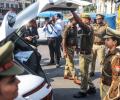
A woman doctor arrested in connection with an inter-state terror module was part of Jamaat-ul-Mominaat, an organization launched by Jaish-e-Mohammed, officials said.
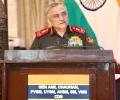
Gen Chauhan said a "whole of the nation" approach will be required to develop the shield.
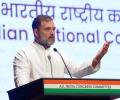
The Bharatiya Janata Party on Wednesday slammed Rahul Gandhi for his 'surrender' barb at Prime Minister Narendra Modi, saying it is not only a grave insult to the armed forces and country but also no less than treason.

The Indian and Pakistani militaries targeted each other's installations using missiles in the last over 12 hours, further escalating the already tense conflict situation.
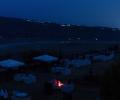
Meanwhile, a precautionary blackout has been enforfced in the multiple areas amid the esclating tensions between India and Pakistan.
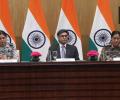
Colonel Sofiya Qureshi revealed that 300 to 400 drones were deployed across 36 locations, with several being shot down by Indian forces using both kinetic and non-kinetic methods.

'The Pakistani government's growing fear of Dr Mahrang's rising popularity is evident.' 'Her defiance is inspiring.'
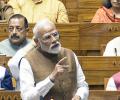
What was the aim of Operation Sindoor? Why was the operation halted so soon? asks Lieutenant General Prakash Katoch (retd).

Tensions between India and Pakistan are escalating following last week's dastardly terror attack in Pahalgam that claimed 26 lives.

"In the coming days if we see a political or constitutional upheaval in Pakistan, or an increase in instability, then we cannot rule out the possibility of another coup in the country," said defence expert Sanjeev Srivastava.
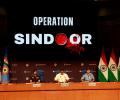
'We should not just react when a terror attack happens on our soil.' 'Our approach should be continuous and a launch pad should be destroyed the moment it comes up.'

'The struggle of insurgents and pro-independence political activists is fuelled by a deep conviction that not only is a free Balochistan possible, but they also believe that Pakistan will inevitably break apart, leading to Balochistan's independence.'
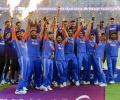
'There has been no gentlemanness in the game. There have been very rude, arrogant gestures on the field.'
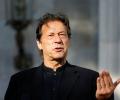
Pakistan media reports stated that the decision to oust Imran Khan was taken by Bajwa and three senior lieutenant generals at a meeting which took place after the army chief and Lieutenant General Nadeem Anjum -- director-general, Inter Services Intelligence, the ISI -- met Imran Khan.
Following the deadly Pahalgam attack, Michael Rubin, a former Pentagon official and senior fellow at the American Enterprise Institute, issued a strong statement and said that 'it is now the duty of India to do to Pakistan and to Pakistan's Inter-Services Intelligence (ISI) what Israel did to Hamas', calling for decisive action against Pakistan's intelligence agency for its alleged role in supporting terrorism.

The four Indian Army personnel, whose helicopter mistakenly landed in Pakistan-held territory on Sunday, were grilled for nearly four hours but were treated well. Army sources on Monday said that Pakistan army personnel questioned the two pilots and two crew members about how they came there and other related issues in an effort to ascertain their motives.
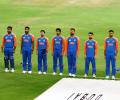
Asian Cricket Council chairman Mohsin Naqvi, who is also the PCB chief, walked away with the Asia Cup trophy after India refused to take the silverware from his hands.
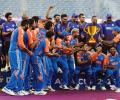
Eventually, the speculations cleared up after it was confirmed by the BCCI secretary Devajit Saikia. He disclosed that India had refused to accept the Asia Cup trophy during the presentation ceremony from ACC Chairman Naqvi, who also serves as Pakistan's interior minister.
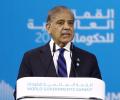
Pakistan Prime Minister Shehbaz Sharif said on Tuesday that his country respects Russia's relations with India, as he called for strengthening Islamabad's ties with Moscow during his talks with Russian President Vladimir Putin in Beijing.
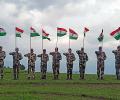
With respect and gratitude we honour the memory of soldiers who sacrificed their lives in Operation Sindoor.

The slain man was identified as Mohammed Shabbir Malik, a Pakistani national, equipped with weapons, ammunition and warlike stores.
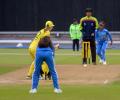
Nepal turmoil: Kathmandu dropped as neutral venue for Blind T20 CWC for women

The Congress leadership is reportedly upset with former Home Minister P Chidambaram for his remarks on 'Operation Blue Star'. Party sources indicate that senior leaders should be cautious about making public statements that could embarrass the party.
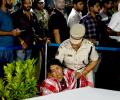
The ISI strategy has been to use its proxies to target Hindus in India. They want an outrage and counter-targeting of India's minorities. Further, even the whiff of it restores the Pakistan army's popularity, especially when it's in the dumps, like now, points out Shekhar Gupta.

The Quetta-bound Jaffar Express was targeted in the Spizend area of Mastung on Tuesday, latest in a series of attacks that have targetted this train since March this year.
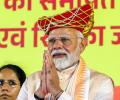
"In Pahalgam, terrorists not only shed the blood of Indians, but also attacked our culture. They tried to divide our society and the biggest thing is that the terrorists have challenged the women power of India," Modi said.

Pakistan is "in an active counterterrorism fight right now and they have been a phenomenal partner in the counterterrorism world", the general said.

A blast on a railway track in Pakistan's Sindh province derailed five bogies of a train, injuring several people. The Peshawar-bound Jaffar Express has been attacked multiple times this year.

Chief of Defence Staff Gen Anil Chauhan asserted that the armed forces are free of nepotism and urged children to join to serve the nation. He also spoke about Operation Sindoor and the use of technology in warfare.
Terrorism and insurgency in J&K had subsided when India demolished East Pakistan -- for the simple reason that Pakistan understands power. We need to follow Chanakya's dictum of Saam, Daam, Dand, Bhed for strategising against Pakistan, asserts Lieutenant General Prakash Katoch (Retd). The ground truth is that unless we are prepared to acknowledge our shortcomings, including massive intelligence failures, punish those responsible and take corrective actions, we will continue in the same vein, asserts Lieutenant General Prakash Katoch (Retd).
'But that was not our aim. Our objective was already achieved.'
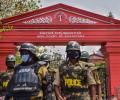
The Karnataka high court has granted an interim stay on criminal proceedings initiated against Bharatiya Janata Party leader Amit Malviya and Republic TV's Editor-in-Chief Arnab Goswami, in connection with allegations of spreading false claims that the Indian National Congress (INC) operates an office in Istanbul, Turkiye.
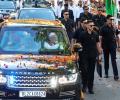
'It is important India to stay focussed on its primary national objectives: Combating terrorism; not losing sight of other security and strategic concerns (on the Sino-Indian front for instance); ensuring a strong economy and registering growth which includes improving the lot of common people; and finally making certain that the social fabric remains intact and harmony among people is not jeopardised, at least any further,' asserts Nilanjan Mukhopadhyay.

Pakistani drones were intercepted by Indian air defence in Jaisalmer. Explosions were heard and flashes seen in the sky.

India recognised acts of gallantry by armed forces personnel and senior military officers involved in Operation Sindoor, along with other distinguished service awards, on the eve of the 79th Independence Day.

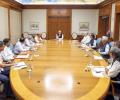
The CCS meet was held at the prime minister's Lok Kalyan Marg residence, a day after he held a meeting with the top military brass and accorded operational freedom to the armed forces on the "mode, targets and timing" of India's response to the April 22 attack that killed 26 people.

The Indian Army is one of the very few armies in the world that operates tanks at high altitudes up to 16,000 feet, and in large numbers.
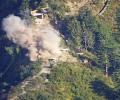
"Two Pakistan Army soldiers were killed along LoC opposite Naushera sector by Indian Army while retaliating to ceasefire violation by the Pakistan Army there yesterday," sources told ANI on Wednesday.

Prime Minister Narendra Modi addressed a gathering in Dhar, Madhya Pradesh, praising Indian soldiers and promoting the use of 'Swadeshi' goods. He also launched health and nutrition campaigns aimed at women and children.
